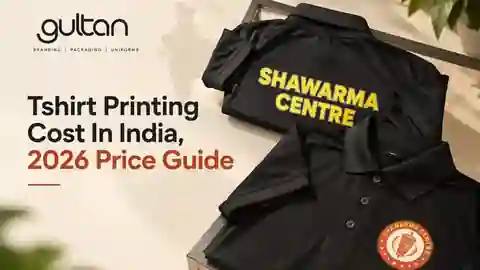
There is no single T-shirt printing cost that applies to every order. What you pay per piece depends on the garment and its fabric, the printing method, how complex the artwork is, how many places it is printed, how many pieces you order and how they are finished and packed. Two orders that look alike on paper can be priced very differently once these details are fixed.
This guide explains what drives the price of a custom T-shirt in India, how the main printing methods compare, and where quantity starts to change the economics. It also sets out exactly what Gultan’s ₹299 starting price includes, so you can tell a general cost factor apart from a specific quote.
T-shirt printing cost at a glance
Gultan’s starting price is ₹299 per T-shirt for one specific package. Here is what it covers:
- Garment: a polyester T-shirt.
- Printing: sublimation printing on both the front and the back.
- Packaging: standard packaging.
- Design assistance: help with placing your logo and preparing your artwork. Creating a completely new design is not included.
- Not included: GST and delivery charges, which are added to the quote.
- Minimum order: 20 pieces per design. Sizes can be mixed within a design.
As an illustration, if all 20 pieces qualify for this package:
20 pieces × ₹299 = ₹5,980, before GST and delivery charges.
| Pieces | Starting price per T-shirt | Base total, before GST and delivery |
|---|---|---|
| 20 | ₹299 | ₹5,980 |
| 50 | ₹299 | ₹14,950 |
| 100 | ₹299 | ₹29,900 |
Illustrative arithmetic at the starting price, assuming every piece qualifies for the package. From 100 pieces there is often more room to discuss pricing, so a real quote can differ.
That figure is a base calculation, not a quotation. A cotton T-shirt, a different printing method, embroidery or a heavier garment changes the price, and your final quote reflects the actual specification.
₹299 is Gultan’s starting price for this package. It is not an average for the Indian market, and it does not apply to every fabric or printing method.
What determines T-shirt printing cost?
Most T-shirt printing prices are built from the same handful of decisions. Knowing them helps you read a quotation and compare suppliers fairly.
- Garment type and fabric. The blank T-shirt is often the largest single part of the cost. A polyester T-shirt, a cotton T-shirt and a polo are different products with different prices before anything is printed on them.
- Fabric weight and quality. Heavier fabric, better yarn and finer construction usually cost more. Whether that is worth paying for depends on how the T-shirt will be used.
- Printing method. Sublimation, DTF printing, screen printing and embroidery each have their own set-up, materials and labour. The right method depends on your artwork and quantity as much as on price.
- Artwork complexity. A one-colour logo is simpler to reproduce than a detailed, multi-colour illustration, especially with methods that need preparation for each colour.
- Print size and number of placements. A small chest logo is not priced the same as a large back print, and each extra position, such as a sleeve, adds work.
- Number of colours. With screen printing in particular, every additional colour usually means another screen and more preparation.
- Order quantity. Set-up work is shared across more pieces in a larger order, which can bring the cost per piece down.
- Custom garment details and finishing. Contrast collars, coloured ribs, custom labels or individual packing add cost and may need larger quantities.
- Packaging and delivery. Standard packaging is part of Gultan’s starting package. GST and delivery are always charged on top.
| Cost factor | Usually keeps the cost lower | Usually adds to the cost |
|---|---|---|
| Garment and fabric | Polyester or polycotton basics | Heavier cotton, premium blanks, polos |
| Print size and placements | One or two positions | Large prints, extra positions such as a sleeve |
| Number of colours | One or two flat colours | Many colours, especially with screen printing |
| Order quantity | Larger runs of one design | Runs close to the 20-piece minimum |
| Garment details | A standard stock garment | Contrast collars, coloured ribs, custom labels |
| Packaging and delivery | Standard packaging, included | Individual or custom packing; delivery by address |
When you compare quotes, check what each one includes. A lower unit price that leaves out packaging, a second print position or delivery may not be lower in the end.
DTF vs. screen printing: which is more economical?
Neither method is cheaper for every order. Which one costs less depends on the design, the number of colours, the print size, the garment and the number of pieces.
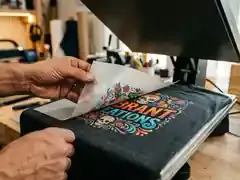
DTF transfer on a heat press.
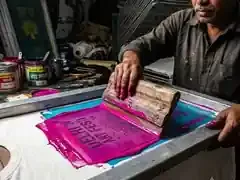
Screen printing, one colour at a time.
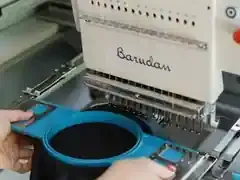
Embroidery on a machine hoop.
DTF T-shirt printing
DTF, short for direct-to-film, is one of the most common methods of digital printing on T-shirts. The design is printed onto a special film, coated with an adhesive powder and then heat-pressed onto the garment. Because the design is printed digitally, it can carry many colours, gradients and fine detail without preparing a separate screen for each colour.
That makes DTF T-shirt printing a practical choice for colourful artwork, detailed logos and comparatively small batches, provided the garment and the design suit it. The cost mainly follows the print size, the number of placements and the quantity. A very large print on every piece of a big order may not stay the most economical option.
Screen T-shirt printing
Screen printing, often called silk screen printing, pushes ink through a prepared mesh screen, with one screen for each colour in the design. Preparing those screens is work that happens once per design, whatever the quantity.
This is why screen T-shirt printing tends to suit repeated designs, larger batches and artwork with a limited number of flat colours. The set-up is spread across many pieces. On a small order, or a design with many colours, that preparation weighs more heavily on each T-shirt.
Sublimation: the method behind the ₹299 package
Gultan’s starting package uses sublimation, which works differently from both DTF and screen printing. The design is printed with special inks that turn to gas under heat and bond with polyester fibres, so the colour becomes part of the fabric rather than a layer on top of it. Sublimation needs polyester fabric and generally works best on white or light-coloured garments. It is not used on cotton.
How to choose between the methods
A few questions usually point to the right method:
- How many pieces? Small batches often lean towards a digital method. Larger runs of one design can make screen printing worthwhile.
- How complex is the design? Many colours, gradients or fine detail favour a digital method. A bold one- or two-colour logo suits screen printing well.
- How much of the T-shirt is printed? Large or multiple prints change the cost of each method differently.
- What is the garment? Sublimation needs polyester. Other methods work on a wider range of fabrics.
- How should it look and feel? A print that is part of the fabric, a print that sits on top, or a stitched logo each give a different finish.
| Sublimation | DTF printing | Screen printing | Embroidery | |
|---|---|---|---|---|
| Works on | Polyester, usually white or light | Cotton, polyester and blends | Most fabrics | Most fabrics, including polos |
| Colour and detail | Full colour, gradients | Full colour, fine detail | Best with a few flat colours | Simple shapes and short text |
| Suits | From the 20-piece minimum | Small to medium runs | Larger runs of one design | Small chest logos |
| Finish | Part of the fabric, no layer | Smooth layer on top | Bright ink on the surface | Raised, stitched texture |
If you are unsure, share your artwork and quantity, and the method can be recommended from the actual specification.
How fabric and T-shirt quality affect cost
The fabric decides how a T-shirt feels to wear, how it holds up to washing and how the print looks. It is also one of the biggest levers on price.
Cotton T-shirts
Cotton is a familiar choice for comfort and a soft feel, and cotton T-shirt printing is common for events, merchandise and everyday wear. Cotton quality varies widely, though, and not every cotton T-shirt is more comfortable or more durable than every alternative. Cotton also rules out sublimation, so it is usually printed with another method.
Polyester, dry-fit and polycotton options
In Gultan’s experience, dry-fit and polycotton fabrics are often worth considering when they suit how the T-shirt will be used and help the order fit the budget. Dry-fit fabrics are designed to move sweat away from the skin, which can help staff who are on their feet all day. Polycotton blends combine cotton with polyester and are a common middle ground. Polyester is also what makes sublimation possible.
None of these is better than cotton in every situation. The right fabric is the one that suits the people wearing it and the work they do.
When premium garments make sense
Premium T-shirt printing, with heavier fabric, better construction or extra finishing, makes sense when the use justifies it. That might be merchandise people buy and keep, a uniform that represents a premium brand, or a garment that has to look sharp after many washes.
High quality T-shirt printing is not only about the most expensive blank. It is a garment and method suited to the job, with artwork prepared properly and a print that stays clear and readable. For a one-day event, a simpler garment may serve the purpose just as well.
| Fabric | Feel and typical use | Works with sublimation |
|---|---|---|
| Cotton | Soft and familiar; events, merchandise, everyday wear | No |
| Polyester | Light and smooth; the base of the ₹299 package | Yes |
| Dry-fit | Moves sweat away; kitchens, active roles, outdoor events | Usually, as most dry-fit is polyester |
| Polycotton | A cotton and polyester mix; everyday staff wear | Limited, depending on the polyester content |
How order quantity affects price and customisation
Quantity changes both the price and what is possible. The general principle is simple: set-up and preparation are shared across more pieces as the order grows. The thresholds below come from Gultan’s own experience, not from a fixed industry rule.
- 20 pieces: Gultan’s minimum order is 20 pieces per design. Many of the hospitality orders we see are between 20 and 100 pieces: a café, restaurant or hotel team with a mix of sizes.
- 100 pieces and more: there is generally more room to discuss pricing, depending on the garment and printing requirements.
- Around 300 pieces: a wider range of garment customisation can become possible, such as differently coloured ribs or collars. These are possibilities to discuss, not standard inclusions.
- 500 pieces and more: orders can become particularly economical, depending on the garment, design, printing method, colours and production details.
- 20Minimum per design
- 100+More room to discuss price
- 300+Custom ribs and collars possible
- 500+Can be particularly economical
None of these thresholds guarantees a discount. How much quantity helps depends on the garment, the method, the number of colours and the set-up involved. A quote for your actual specification is the only reliable figure.
T-shirt printing cost in Mumbai and Navi Mumbai
If you are comparing T-shirt printing cost in Mumbai, the factors in this guide all apply: the garment, the method, the artwork, the quantity and delivery. A T-shirt printing price in Mumbai that looks low may leave out a second print position, packaging or delivery, so compare what each quote includes. Gultan’s studio is in Navi Mumbai, and we take orders from businesses across Mumbai and Navi Mumbai.
Gultan’s starting package is the same across both: ₹299 per polyester T-shirt with sublimation on the front and back, standard packaging and design assistance, with a minimum of 20 pieces per design. GST and delivery are added to the quote, and delivery charges depend on the quantity and the address.
If you need digital printing on T-shirts in Mumbai for colourful artwork, DTF printing is the digital method we use alongside screen printing and embroidery. For more on minimums, garment types and how to order, see our T-shirt printing in Mumbai page. If you are based in Vashi, Nerul, Kharghar or elsewhere in Navi Mumbai, our Navi Mumbai T-shirt printing service covers the same options. For staff uniforms and custom polo T-shirts, see our Wear page.
Practical tips for reducing your T-shirt printing budget
These are the decisions that, in Gultan’s experience, most often help an order fit its budget. They are ways to make informed choices, not guaranteed savings on every order.
- Consider dry-fit or polycotton where the fabric suits the work your team does.
- Consider DTF for colourful designs or smaller batches when it fits the garment and the artwork.
- Choose standard garment colours that are usually in stock, when they work for your brand.
- Skip embroidery or premium fabric if the T-shirt’s use does not need it.
- Finalise the design and print placement before production, so nothing changes once printing starts.
- Confirm quantities and the size split before you approve the order.
- Review a mock-up before approving production, so the colours and placement are what you expect.
- Give clear specifications when you ask for a quote. The clearer the brief, the more accurate the price.
Common mistakes that can affect your T-shirt order
Most problems with a T-shirt order start before printing. These are the ones we see most often.
Submitting a low-resolution logo
Many small businesses have only one version of their logo, often a small image taken from a website or a social media profile. Printed at chest or back size, a low-resolution file can come out blurred or jagged.
Gultan can assess the artwork you supply and improve its quality where the source allows. How far that goes depends on the file and the detail available in it. Creating a new logo or a full brand design is a separate service and is not part of the ₹299 package. If you have a vector file (AI, EPS, PDF or SVG) or a high-resolution PNG, send that.
Finalising the order without confirming staff sizes
When different people will wear the T-shirts, guessing the size split is a common reason for reorders. Collect each person’s size, or at least a reliable split, before you confirm the quantity.
Gultan shares size guides in more than one unit of measurement, which makes it easier for each team member to pick the right size.
Choosing a T-shirt colour without checking logo contrast
A logo that stands out on a white screen can almost disappear on a garment in a similar shade. For café, restaurant and hotel teams, the logo often needs to be readable from across a counter or a dining room.
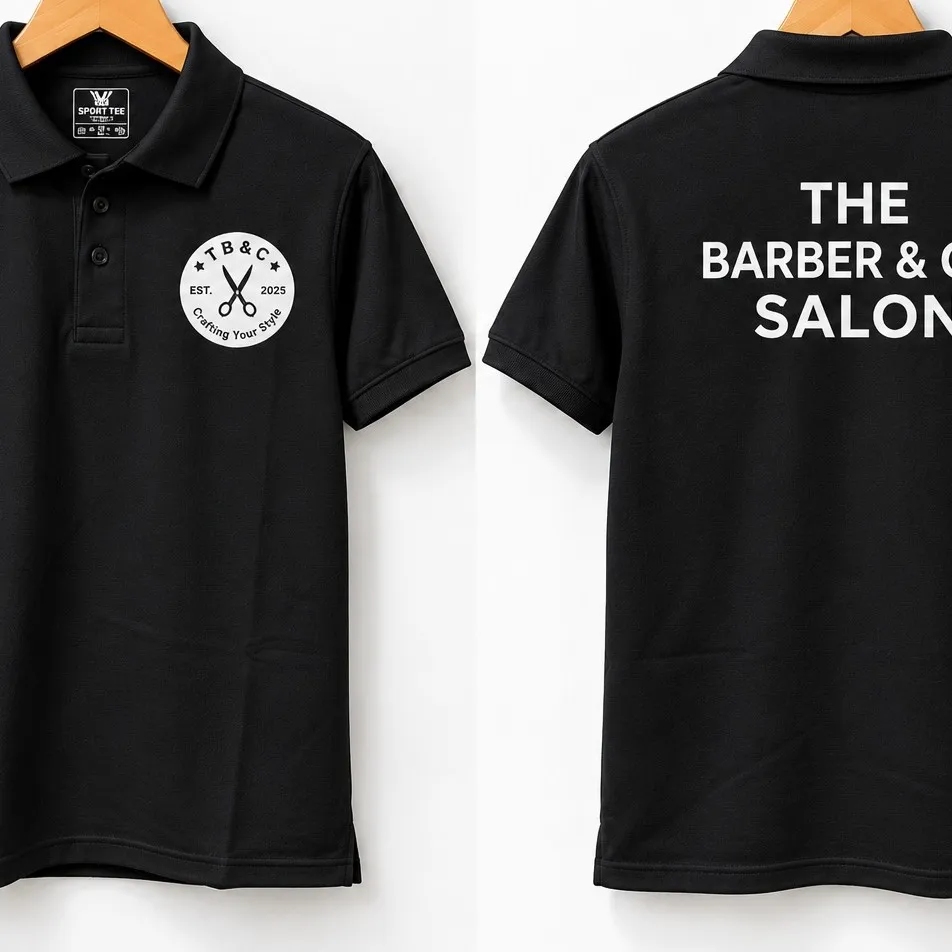
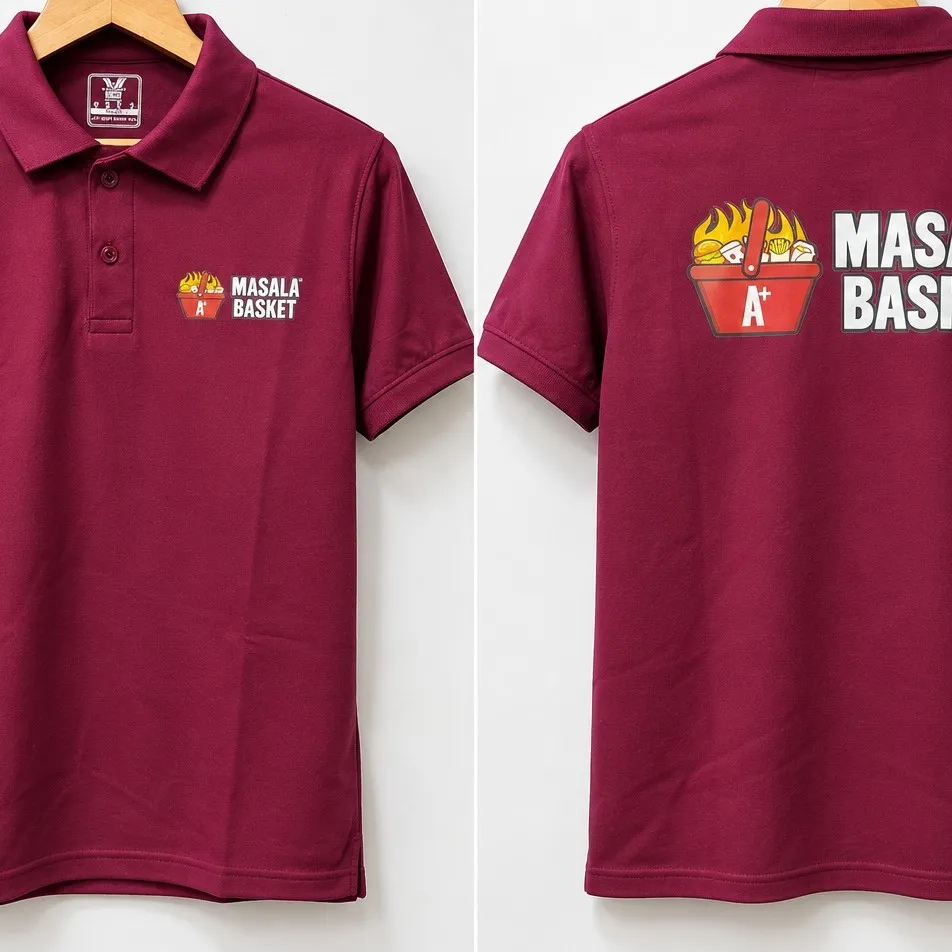
Review the logo and garment colour together before production. Standard garment colours are usually in stock, but the right choice depends on contrast and brand requirements.
Check the garment colour and the logo colour together, ideally on a mock-up, before you approve production. A light logo on a dark garment, or the reverse, is usually the safest combination.
Choosing the cheapest option without considering its use
A kitchen team working through long, hot shifts needs something different from an event crew wearing T-shirts for one afternoon. In hospitality, staff value comfort through the shift, a logo that stays visible, garments that suit the working environment and sizes that fit the whole team. Repeat orders also need to match the first batch.
In Gultan’s experience, hospitality T-shirts chosen for their actual use often stay in service for six months or more. Judge the garment by how it will be worn, not by the unit price alone.
Frequently asked questions
How much does T-shirt printing cost?
T-shirt printing cost depends on the garment and fabric, the printing method, the artwork, the number of print positions, the quantity and delivery. At Gultan, the starting price is ₹299 per T-shirt for a polyester T-shirt with front and back sublimation, standard packaging and design assistance, excluding GST and delivery. Other specifications are quoted separately.
What is included in Gultan’s ₹299 T-shirt printing package?
A polyester T-shirt, sublimation printing on the front and back, standard packaging, and design assistance with your existing artwork. Creating a completely new design is not included. GST and delivery charges are extra.
What is the minimum order quantity at Gultan?
The minimum order is 20 pieces per design. Sizes can be mixed within that design.
Does the price change for larger orders?
It can. In Gultan’s experience, orders of 100 pieces or more usually leave more room to discuss pricing. From around 300 pieces, more garment customisation, such as coloured ribs or collars, can become possible. Orders of 500 or more can be particularly economical. The actual effect depends on the specification, so there is no fixed discount.
Is DTF or screen printing cheaper?
It depends on the artwork, the number of colours, the print size, the quantity and the garment. DTF printing often suits colourful designs and smaller batches. Screen printing often suits larger runs of a design with a few flat colours. Neither is cheaper for every order.
What information do I need to request a quotation?
The approximate quantity, your preferred garment or fabric, your logo or artwork, where you want it printed, the size split and the date you need the T-shirts. The more of this you share, the more accurate the quote.
What affects T-shirt printing prices in Mumbai?
The same factors as anywhere else: the garment, fabric, printing method, artwork, print positions, quantity and delivery address. Gultan’s starting price and 20-piece minimum apply across Mumbai, with GST and delivery added. Our Mumbai T-shirt printing page has more on what to expect.
Get a T-shirt printing quote from Gultan
If you are planning an order, send us:
- The approximate quantity.
- Your preferred garment or fabric.
- Your logo or artwork.
- Your printing requirements: positions, colours and method, if you have one in mind.
- The size split, if you know it.
- The date you need the T-shirts.
These details let us understand what you need and give you a relevant quotation. We can talk through the options with you and prepare a mock-up where it applies. Creating a new design is not part of the starting package.
You can send us your requirements through the enquiry form on our Mumbai T-shirt printing page, or use our contact page.